Big Brands, the Illusion of Choice, and Why Shopping Small Matters

Big Brands, the Illusion of Choice, and Why Shopping Small Matters
If you go to any major big box or grocery store, you'll see shelves and shelves of different brands, different chips, different frozen dinners, different meats, different cleaning products.
What if that was mostly an illusion, and most of those brands were owned by a very small number of different companies?
The reality: most brands are owned by a handful of sprawling, international conglomerates, or SICs, if you will.
These conglomerates are smart! They use different brands and positions to market themselves to consumers, to encourage consumers to buy more. The same SIC can own "New and improved Cleaner!," "Old Reliable Cleaner!" and "Eco-Green Cleaner!"
Familiar branding, shelf space, and curiosity-driven packaging (ie: new, better formula!) drive sales. And if a company has run out of ideas? One way to gain more shelf space and more recognized branding is to buy up smaller, existing brands, pay for premium product placement, carry out large mergers and acquisitions to consolidate power, and lobby the government for things like tax breaks, looser regulations, etc.
The end result: more of your money going into the hands of a small group of corporations.
Because: almost 80% of groceries are supplied by a small handful of these sprawling, international conglomerates AND a handful of these same companies own EVERY link in the food supply chain, from seeds and fertilize, to slaughterhouses, and even supermarkets themselves.
Most food brands are owned by FIVE companies: Kraft-Heinz, General Mills, Conagra, Unilever, and Delmonte.
This level of consolidation and control means these companies get to lobby the government, determine prices (paid to farmers, and that consumers pay), and control our options.
This chart is probably familiar to many:
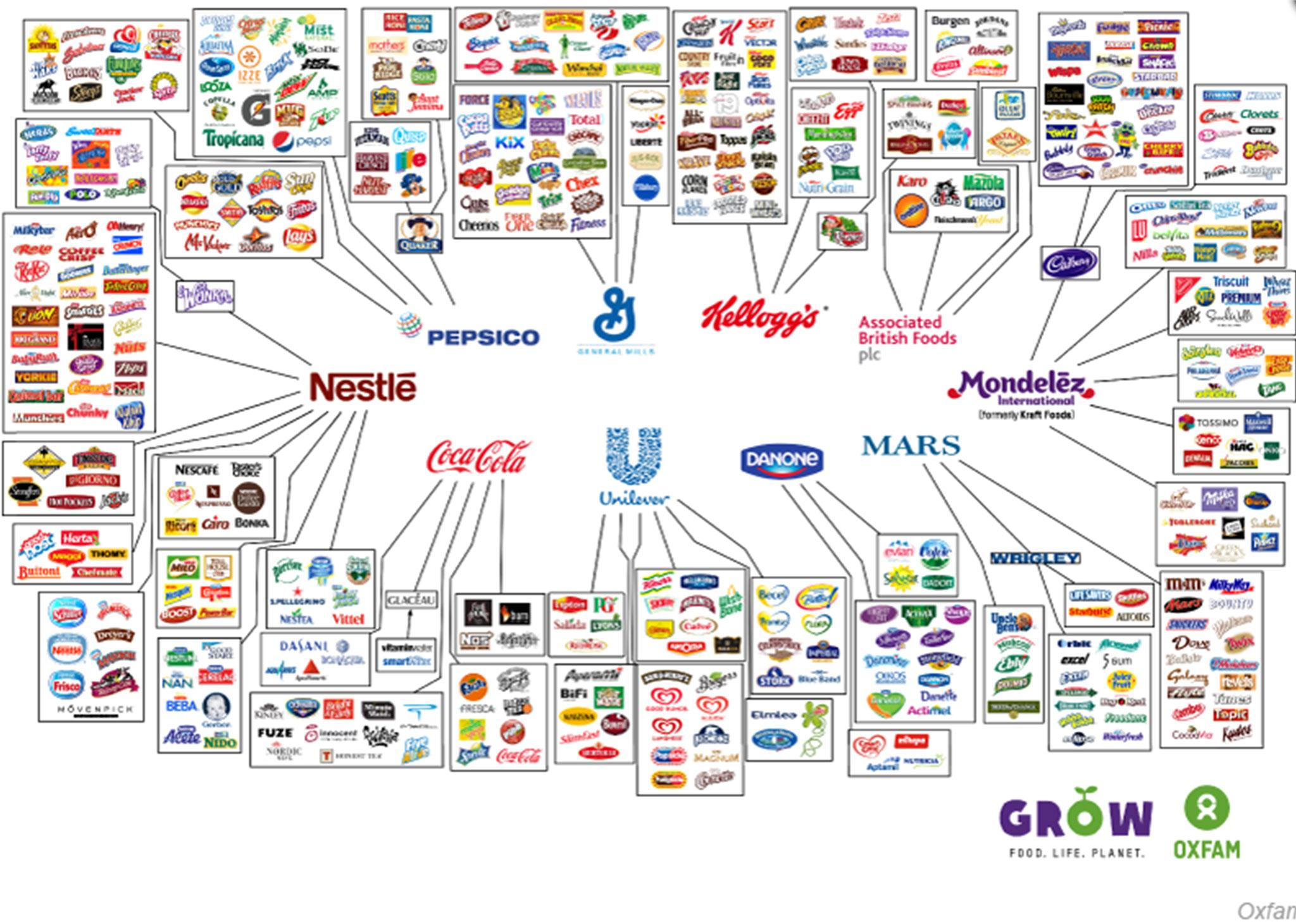
Of course, it's about money.
According to the same linked Guardian study, approximately 15 cents of every dollar spent on food is paid to farmers, the other 85 cents goes to processing and marketing.
These large companies spend millions lobbying the federal government on issues like taxes, trade, labor, agriculture, the environment, etc.
Not ALL of these lobbying efforts are inherently negative, however, these corporations can also work together to set prices paid to farm workers, determine safe working conditions, and set prices consumers pay.
Overall, a company benefits from owning more recognizable brands, having a larger shelf space/presence, and less competition from external brands.
And, in some cases, tax payers subsidize these large corporations.
These sprawling, international corporations benefit from taxpayer dollars via food stamp spending, and subsidies from employees spending said food stamps.
For example: BIG CORP pays a low wage, so their employees qualify for food stamps. The employee spends those food stamps at the grocery store (also a large conglomerate) on BIG CORP products. BIG CORP essentially gets two subsidies- "savings" from paying a low wage, and again when their employees spend food stamps on BIG CORP products.
(Of course, there are other labor issues, such as: the undocumented workers working in fields, orchards, and slaughterhouses who receive little pay, face ICE raids -and ICE threats from employers,- violence, sexual assault, and an often strenuous, dirty, or back-breaking work environment, and have few if any protections.)
Please note: This isn’t a critique of food stamps, people who use them, or undocumented farm workers. It’s a critique of the systems that allow and perpetuate abuses.
Let's take a closer look at common cleaning and personal care brands.
All of the information here is easily found on Wikipedia. Also, each of these companies own many more brands across different sectors (ie pets, beauty, health, etc.)
Proctor & Gamble owns: Bounty, Downy, Dreft, Gain, Tide, Cascade, Dawn, Febreze, Mr. Clean, Swiffer, Tampax, Olay, Pantene, and more. These brands make up ~35% of the companies earnings.
S.C. Johnson & Son: Fantastik, Pledge, Scrubbing Bubbles, Windex, Glade, Saran Wrap, Ziploc, SunBum and many more.
Unilever: 400+ brands in 190 countries total, including: Dollar Shave Club, Dove, Axe, Persil and many more.
Colgate Palmolive: Speedstick, Palmolive, Colgate, Softsoap, Fabuloso, Ajax, and more.
Kimberly-Clark: Huggies, Kleenex, Cottonelle, Depend, Kotex, Scott Toilet Paper, Viva Paper Towels
But the green, eco-, sustainable brands? Aren't those independent?
Not all of them. While there are actual, independent brands, many of the popular eco-brands in stores are actually owned by the same major corporations. Remember, more brands equals more shelf space, a broader audience, and less competition.
- Clorox: Burt’s Bees, Green Works
- Colgate-Palmolive: Tom’s of Maine, hello
- S.C. Johnson: Mrs. Meyers, Method, Ecover, Babyganics, Stasher Bags (this hurts! They’ve got the market nearly cornered on bags now...)
- Proctor & Gamble: Native, 9 Elements
- Unilever: Seventh Generation, Wild, Love Beauty and Planet, Simple Brand, Schmidt’s Naturals, Shea Moisture
- Kimberly-Clark: Thinx Period Panties
- Richard Branson/Virgin Group and Morgan Stanley are large shareholders of Grove Collaborative, which is publicly traded.
The goal of these corporations is to make money, drive out competition, and increase profits for shareholders.
Can a sprawling, multinational, mega-corporation driven by shareholder wants & profit make a truly sustainable product, from source to shelf?
I don't know.
A few actual independent, sustainable cleaning and personal care brands:
- Dr. Bronners
- Blueland
- Dropps
- Meliora
- Rustic Strength
- Green Llama
- ZeroWasteStore
- dip
- BambooSwitch
- Plaine Products
- No Tox Life
- MeMother Earth
- MamaSuds
- Zerra & Co.
- Marley’s
- BioBag
- Greenline Pet
- Nellie’s Clean
- Silver Falls Sustainability
- Diva Cup
- Your local makers and artisans!
- Check your local refill shop, gift shop, boutiques, makers markets for more actually independent brands.
OK, but why should I support small businesses? Sometimes they're more expensive.
Smaller brands and small businesses have more control over their supply chain, sourcing, manufacturing, shipping, employees, etc.
They are not responsible to shareholders and can choose to do things like pay better wages, support their local communities, and use higher quality ingredients. This may translate to a slight increase in price- but it doesn't always.
Smaller brands are, by and large, not spending money on massive lobbying campaigns to weaken safety regulations, cut their own taxes, lawsuit payouts, or high-gloss, low-impact marketing campaigns.
Small, independent, and local brands are owned and run by *people in your community* not a faceless, sprawling, multinational corporation.
Smaller brands give you ACTUAL CHOICES that conglomerates don’t. The choice between Dr. Bronner's and Green Llama is a choice. The choice between Windex and Mrs. Myers is not.
Sprawling corporations consolidate power to control the market, drive up prices, and stop competition. Your local shops are not.
OK this is too long, give me the bite-size version on why to shop small that I can tell all my friends and family:
A handful of sprawling, international conglomerates (SICs) own the vast majority of brands you see in supermarkets, including beauty brands, food brands, and cleaning brands.
These companies are driven by shareholders and profit, leading them to consolidate power to eliminate competition, lobby for favorable regulations, determine prices, and cut corners where they can (ie wages, quality of ingredients, packaging, etc.).
SICs can expand their shelf space, audience, and revenue and cut out competitors by purchasing existing brands, including “eco-friendly” brands.
Small, independent, and/or locally owned brands don’t have the same reach as major brands...
but...
they have more control over their supply chain, manufacturing, pricing, hiring practices, etc. Smaller businesses are run by actual humans who live and pay taxes in your community.